
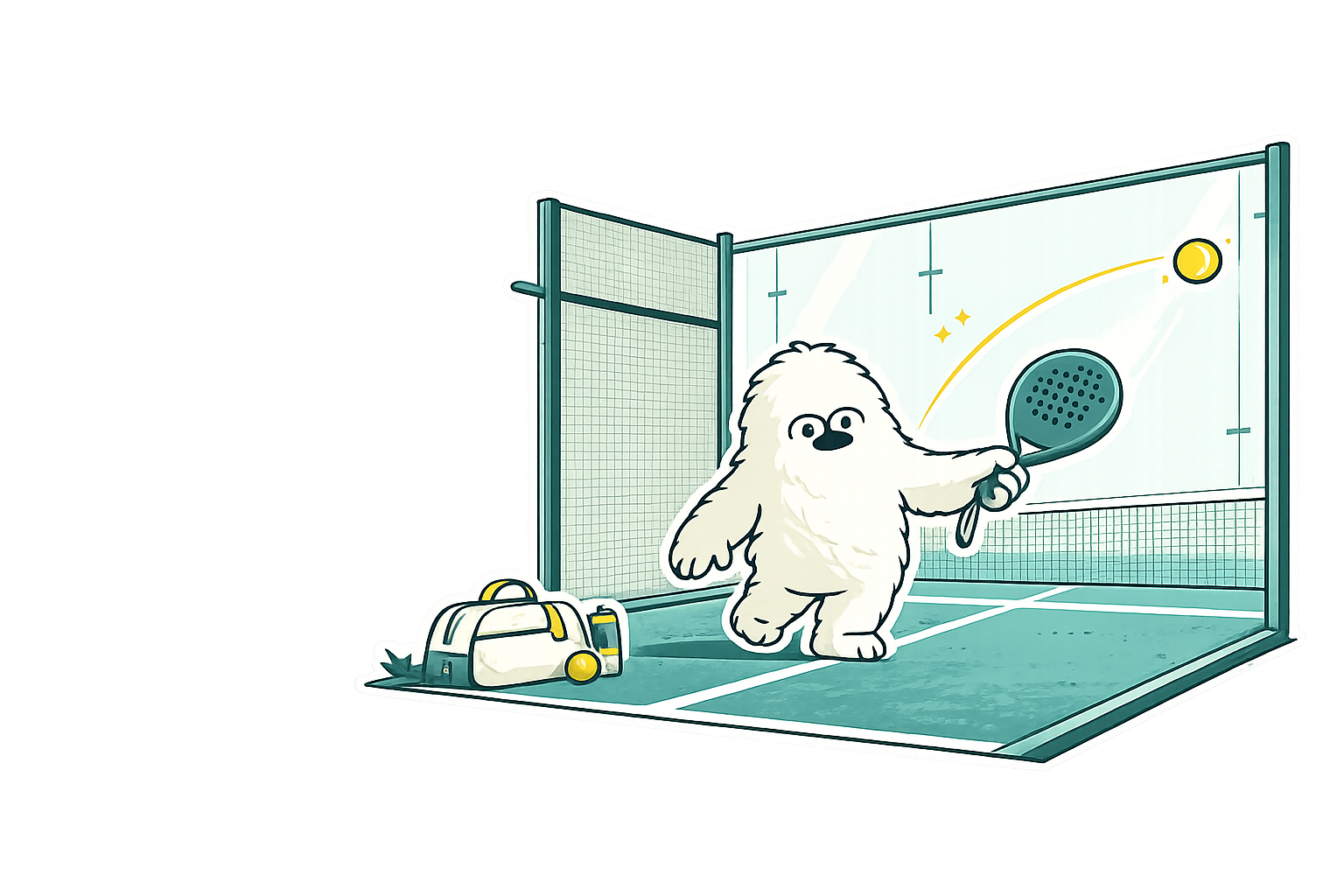
If you have walked past a glass-walled court recently and wondered what on earth was going on inside it, you have already met padel. It is the fastest-growing sport in the UK and Ireland, it takes about ten minutes to learn and a lifetime to master, and this guide will get you from total beginner to booking your first court with confidence.
We run the UK and Ireland's largest padel directory here at padelyeti, which means we spend our days researching courts, prices and clubs across more than 500 towns and cities. This guide is everything we wish someone had told us before our first game.
What is padel?
Padel is a racket sport played in doubles on an enclosed court roughly a third the size of a tennis court. Think of it as the best bits of tennis and squash combined. The scoring, net and underarm serve come from tennis. The walls come from squash: the ball can rebound off the glass and stay in play, which is the thing that makes padel padel.
Two details surprise most newcomers. First, the racket has no strings. It is a solid, perforated bat, shorter than a tennis racket and much easier to control. Second, because the walls keep the ball alive, rallies last far longer than in tennis. Beginners are playing proper, satisfying rallies within their first hour, which is precisely why the sport is spreading so quickly.
Padel was invented in Mexico in 1969, conquered Spain and Argentina, and has now arrived in Britain and Ireland in a big way. When we started tracking venues there were a few dozen clubs. Today our directory lists more than 900 venues across the UK and Ireland, with new courts opening every month.
The court, in plain English
A padel court is 20 metres long and 10 metres wide, enclosed by glass walls at the back and a mix of glass and metal mesh along the sides. The net in the middle sits at 88cm, slightly lower than a tennis net. Each half of the court has two service boxes, just like tennis. If you want every measurement in detail, our padel court dimensions guide has the lot.
The only thing you really need to understand before you play is which surfaces do what:
- The glass is your friend. After the ball bounces on the ground, it can hit the glass and remain in play. You can also let the ball come off your own back glass and return it from there.
- The mesh (the cage) is not your friend. If the ball hits the mesh before bouncing on the ground, the point is over.
- The floor works like tennis. One bounce is fine. Two bounces and the point is lost.
That is genuinely most of it. Everything else is refinement.
What you need to play
One of padel's great advantages is how little kit it demands.
A padel racket. Solid foam core, carbon or fibreglass face, holes drilled through it, and a wrist strap you are required to use. Almost every club rents them for a few pounds, so do not buy one for your first session. When you do buy, a beginner-friendly round-shaped racket costs from around £40.
Padel balls. They look like tennis balls but are slightly smaller and lower pressure, which keeps rallies playable. Clubs sell or provide them.
Trainers. Any clean sports trainers are fine for your first few games. Padel courts use artificial turf with sand infill, so once you are hooked, a pair of padel or clay-court tennis shoes with a herringbone sole will give you far better grip.
Normal sportswear. Shorts or leggings and a t-shirt. There is no dress code at the vast majority of UK and Ireland clubs.
That is it. No membership required at most venues, no whites, no committee approval.
The rules of padel
The serve
Every point starts with an underarm serve. You must let the ball bounce once beside you, then strike it at or below waist height, hitting diagonally into the opposite service box, starting from the right-hand side. You get two attempts, just like tennis.
One wrinkle: if your serve bounces in the service box and then hits the glass, it is a legal serve and play continues. If it bounces in the box and then hits the mesh, it is a fault. And if the serve clips the net before landing in the box, it is a let and you replay it.
During the rally
Once the ball is in play, the logic is consistent:
- The ball must bounce on the ground on your opponents' side before it touches any of their walls. You cannot smash the ball directly into their back glass on the full.
- On your own side, the ball can bounce on the ground and then rebound off your glass, and you can play it after the rebound. This is the shot that feels impossible in week one and completely natural by week four.
- Volleys are allowed anywhere except on the return of serve, which must bounce.
- You lose the point if the ball bounces twice on your side, if you hit it into the net or the mesh, if you or your racket touch the net, or if you hit the ball before it has crossed to your side.
The walls, honestly
Every guide tells you the walls are in play. Very few tell you the truth about learning them, which is this: your instinct for the first two or three sessions will be to panic and swing at every ball before it reaches the glass. Fight that instinct. The single biggest leap a beginner makes is learning to let the ball go, turn, and play it off the back wall with time to spare. Balls that look unreachable are very often coming straight back to you. Patience beats power in padel, every single time.
How scoring works in padel
If you have ever watched tennis, you already know padel scoring. Points go 15, 30, 40, game. Win six games with a two-game cushion and you take the set. At 6-6, you play a tie-break to seven points. Matches are usually best of three sets.
At 40-40 (deuce), most social and club padel in the UK uses the "golden point": one deciding point, with the receiving pair choosing which side receives. Some clubs and competitions play traditional advantage scoring instead, so it is worth agreeing before you start.
Ways to win a point, at a glance:
- Your opponents let the ball bounce twice
- They hit the ball into the net or directly into the mesh or glass without a bounce
- They hit the ball out of the court (with one glorious exception: at many venues a ball hit over the walls can legally be chased through the court's side openings and returned from outside, which is exactly as chaotic and brilliant as it sounds)
- They touch the net, or hit the ball twice
Your first game: what actually happens
This is the part most guides skip, so here is the honest run-through.
Booking. Nearly all UK and Ireland padel is pay-and-play. You book a court online through the club's website or a booking platform, typically in 60 or 90 minute slots. You do not need to be a member at most venues, and you do not need to know other players: the majority of clubs run open sessions, often called Americanos or social mixers, where you turn up alone and get rotated into games with people of a similar standard.
Cost. Court hire is usually split four ways, and across the hundreds of venues where we track real pricing, a typical peak-time game works out somewhere between £5 and £12 per person per hour, with off-peak often cheaper. Racket hire adds a couple of pounds. As racket sports go, it is refreshingly affordable.
Standard. Do not worry about being terrible. Everyone in the UK started recently, which is one of padel's quiet superpowers: there is no entrenched class of players who have been swinging since childhood. Clubs grade sessions by level, and complete-beginner sessions are exactly that.
Etiquette. Call "mine" or "yours" early and loudly, wait for a break in play before walking behind a live court, and return stray balls to their court between points. That covers ninety percent of it.
Five tips that will make you instantly better
- Stand side by side with your partner. Move up to the net together and drop back together. The pair that controls the net wins most points at every level.
- Shorten your swing. Padel punishes big tennis backswings. Compact, controlled strokes with the racket out in front of you win rallies.
- Lob more than feels reasonable. A deep lob over the heads of a pair at the net is the most effective shot in beginner padel, and probably in all padel.
- Let it go to the glass. When a ball is driven past you, turn and follow it rather than lunging. It will come back off the wall.
- Aim for consistency, not winners. In doubles on a small court, the pair that puts one more ball back in play wins. Spectacular smashes can wait.
Common beginner mistakes
Serving overarm (not allowed). Standing in no man's land in the middle of the court, where every ball lands at your feet. Trying to hit through the back glass for winners instead of over the net with height. Ignoring your partner. And giving up on balls that the wall would have handed straight back to you.
Where to play padel near you
This is where we can genuinely help. padelyeti lists every padel venue in the UK and Ireland, over 900 of them and counting, with verified court counts, real pricing where we have been able to confirm it, and details of indoor and outdoor courts. Search your town or city in our venue directory and you will almost certainly find a court closer than you expect. And if there is nothing near you yet, check our opening soon list, because there very probably will be shortly.
Frequently asked questions
Is padel easier than tennis?
For beginners, yes, significantly. The underarm serve, stringless racket, smaller court and forgiving walls mean new players sustain real rallies within their first session, something that can take months in tennis.
Can you play padel with two players?
Standard padel is doubles on a 10-metre-wide court. Singles padel exists on narrower six-metre courts, but these are rare in the UK and Ireland. Book as a four if you can.
Do I need my own racket to start?
No. Almost every club rents rackets for a small fee. Play a few times with rentals before spending money on your own.
Can you play padel in normal trainers?
For your first few games, yes, any clean sports trainers will do. Regular players should move to padel-specific or clay-court shoes for better grip on the artificial turf.
What is the difference between padel and paddle tennis?
They are different sports. Padel is the glass-walled doubles game described in this guide. Paddle tennis (and its American cousin, platform tennis) is played on a smaller court without the same wall rules. In the UK and Ireland, "padel" is the one you keep seeing everywhere.
How long does a padel match last?
Court bookings typically run 60 or 90 minutes, and a casual best-of-three match fits comfortably inside that. Social sessions usually rotate games on a timer.