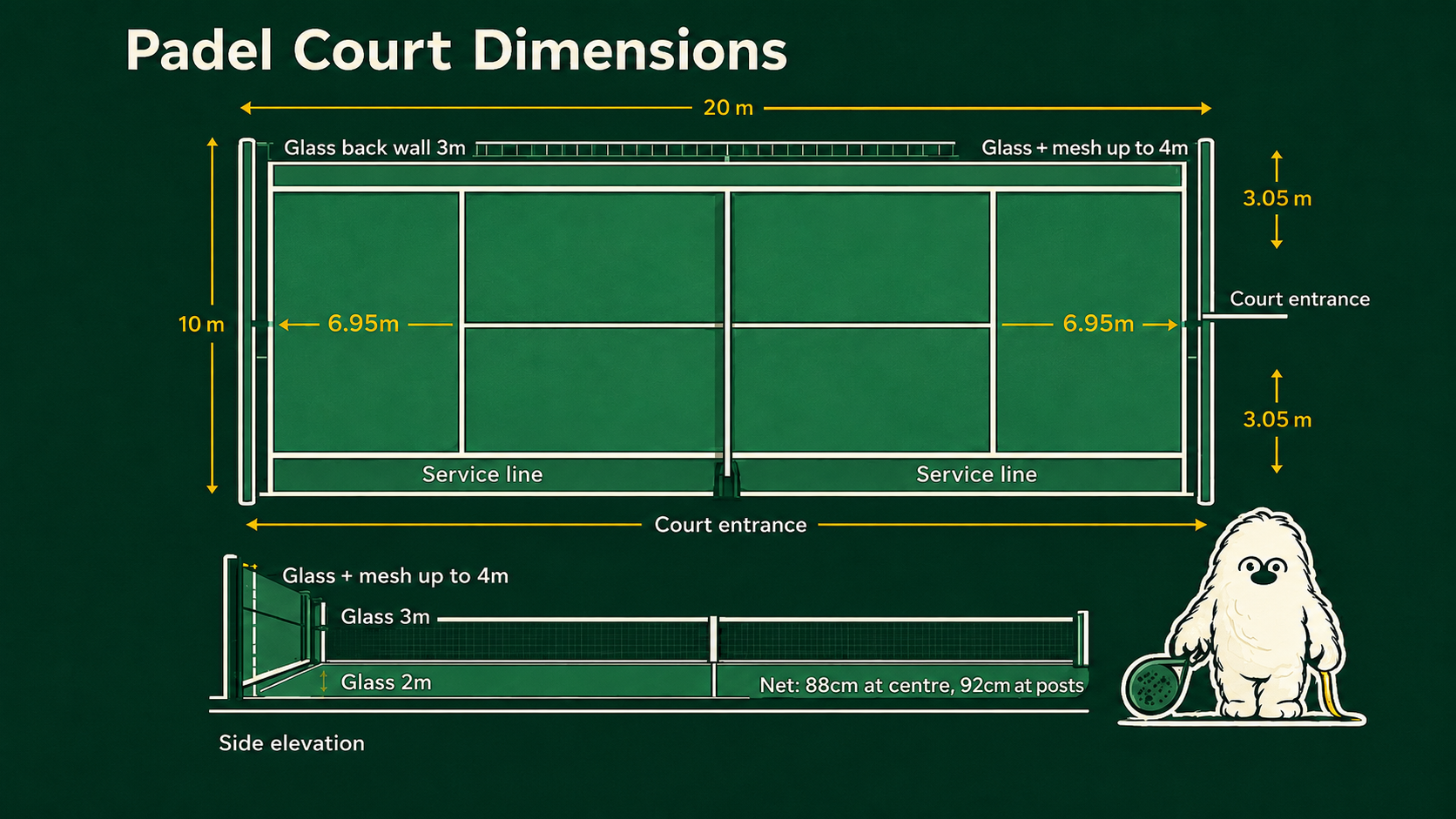
Every padel court in the world is built to the same footprint, which makes the dimensions refreshingly easy to learn. This page covers the official measurements, the markings, the wall heights and how much space you actually need, whether you are settling an argument, planning a build or just wondering why the net looks so low.
The headline numbers
A standard padel court is 20 metres long and 10 metres wide, exactly twice as long as it is wide. In imperial terms that is 65.6 feet by 32.8 feet. The court is divided across the middle by a net that stands 88cm high at the centre, rising to 92cm at the posts. That low net is one of the first things that surprises people who arrive from tennis, where the net is over a metre at the posts.
The markings
Padel keeps its floor markings minimal:
- The service line runs across each half, 6.95 metres from the net. That leaves just over 3 metres between the service line and the back glass, and serves must bounce inside this area.
- The centre service line splits each service area into two service boxes, left and right, exactly as in tennis.
- All lines are 5cm wide and must contrast with the court surface, which is why you will usually see white or yellow lines on blue, green or terracotta turf.
There are no tramlines, no baselines and no doubles alleys. The walls do the rest of the work.
The walls and enclosure
The enclosure is what makes a padel court a padel court, and its heights are specified precisely:
- Back walls are glass to a height of 3 metres, topped by metal mesh to a total height of 4 metres.
- Side enclosures combine glass and mesh between 3 and 4 metres high. On a classic court the glass steps down from the back corners; on the increasingly popular panoramic courts the back glass is a single uninterrupted wall for better spectator views.
- Openings sit on each side of the court beside the net posts, serving as the entrances. At many venues players can legally run out through them to chase a lobbed ball, one of the sport's great spectacles.
The glass is toughened safety glass, usually 10 or 12mm, because it is very much part of the playing surface: the ball rebounds off it and stays in play.
Height clearance
For indoor and covered courts, the minimum recommended clear height is 6 metres above the whole playing area, free of beams, lights and other obstructions. Competition venues typically want 8 metres or more so that lobs are never compromised. This is the measurement that catches out the most conversion projects, because plenty of industrial units are wide enough for a padel court but too low for one.
The playing surface
The standard surface is sand-dressed artificial turf laid over a porous base, which provides consistent bounce, reliable grip and all-weather drainage. Blue is the most common colour in the UK and Ireland, with green and terracotta close behind. This surface is also why proper padel or clay-court shoes with a herringbone sole grip so much better than smooth-soled trainers.
How does a padel court compare to a tennis court?
A tennis court's playing area is 23.77 metres long and up to 10.97 metres wide for doubles, but the fenced plot around it is far bigger, typically around 36 by 18 metres once runbacks are included. A padel court's total enclosure is barely larger than its 20 by 10 playing area, which is why padel is often described as taking up about a third of the space of tennis. It is also why so many tennis clubs are converting: a standard fenced tennis court plot can typically accommodate two padel courts, sometimes three depending on access and orientation.
What about singles padel courts?
Singles padel is played on a narrower court, 20 metres long by 6 metres wide, with the same net height, service line distance and wall construction. They remain rare in the UK and Ireland, so if you are booking a court you can safely assume it is the standard doubles size. If you are curious how the game itself works on either court, our complete beginner's guide covers the rules and scoring.
How much space do you need to build a padel court?
The court itself needs a level 20 by 10 metre base, but a realistic plot allows roughly 21 by 11 metres to accommodate the structure and foundations, plus access around at least one side for construction and maintenance. Add the 6 metre height requirement if you are putting a roof over it. Land, groundworks, drainage and lighting usually shape the budget more than the court structure itself.
Quick reference
- Court length: 20m (65.6ft)
- Court width: 10m (32.8ft)
- Net height: 88cm at the centre, 92cm at the posts
- Service line: 6.95m from the net
- Back walls: 3m glass, 4m total with mesh
- Side enclosure: 3m to 4m, glass and mesh
- Minimum indoor clear height: 6m (8m for competition)
- Singles court: 20m x 6m
- Surface: sand-dressed artificial turf
Frequently asked questions
How big is a padel court?
A standard padel court is 20 metres long by 10 metres wide, which is 65.6 feet by 32.8 feet. Including the enclosure, a plot of roughly 21 by 11 metres is needed.
How high is a padel net?
A padel net is 88cm high at the centre and 92cm at the posts, noticeably lower than a tennis net.
How high are the walls on a padel court?
The back walls are glass to 3 metres, topped with mesh to 4 metres. The side enclosures combine glass and mesh between 3 and 4 metres high.
Is a padel court smaller than a tennis court?
Yes, substantially. Including runbacks, a padel court takes up roughly a third of the space of a tennis court, and a standard fenced tennis court plot can typically fit two padel courts.
What ceiling height do you need for indoor padel?
A minimum of 6 metres of clear, unobstructed height over the whole court, with 8 metres or more preferred for competition play so that lobs are never restricted.
Now you know exactly what you are standing on. To see how many of these courts exist near you, live counts and all, head to our padel courts hub or search the full venue directory.